
第六章 如何坚守和如何迭代你的北极星
目录
- How to Sense if Your North Star is Working
- 如何感知你的北极星是否正在工作
- When to Change Your North Star
- 什么时候改变你的北极星
- Keeping Your Momentum
- 保持动力
- Chapter in Review
- 本章回顾
In this chapter, you will learn:
- How to sense if your North Star is working
- What traps to watch for as your North Star is established
- How to re-evaluate and even change your North Star
在这一章中,你将学到:
- 如何感知你的北极星是否起作用
- 当你的北极星建立的时候,你要注意什么陷阱
- 如何重新评估甚至改变你的北极星
How to Sense if Your North Star is Working
如何感知你的北极星是否正在工作
Over time, the North Star should result in improved business performance and happier customers. Even before that, though, you may observe changes within your company. The following are some signals that the North Star framework is working for your organization and your product:
随着时间的推移,北极星应该会带来更好的经营业绩和更快乐的客户。 即使在此之前,你也可以观察到公司内部的变化。 以下是一些信号,表明北极星框架正在为贵组织和贵产品服务:
- Team members can explain how their day-to-day work connects to the North Star Metric.
- You are more confident about the impact of your work and the quality of your decisions.
- Team members report improved morale and cohesion.
- You seem to hear and be able to say 「no」 more easily, and with more evidence.
- The 「battle of ideas」 shifts to discussions about impact and experimentation.
- You notice more productive collaboration.
- People use similar language.
- More people can coherently describe your product strategy.
- Non product-team members start to use the language of the framework, like 「Inputs」 or 「our North Star.」
-
The North Star Metric is mentioned at large company meetings.
- 团队成员可以解释他们的日常工作如何与北极星指标相关联
- 你对自己工作的影响力和决策的质量更有信心
- 团队成员报告说士气和凝聚力有所提高
- 你似乎更容易听到并且自己也能够说「不」 ,而且有更多的证据
- 「思想之争」转向了关于影响和实验的讨论
- 你会注意到更有效率的合作
- 人们使用相似的语言
- 更多的人可以清晰地描述你的产品策略
- 非产品团队成员开始使用框架的语言,比如「输入」或「我们的北极星」
- 在大型公司会议上提到北极星指标
When to Change Your North Star
什么时候改变你的北极星
At some point, a business may recognize that the North Star is no longer effective. Maybe your market has changed or your business is at a different stage. No matter the reason, at some point you could find that your original North Star no longer predicts business success.
在某种程度上,企业可能会意识到北极星不再有效。也许你的市场已经改变了,或者你的生意正处于一个不同的阶段。不管是什么原因,在某种程度上,你可能会发现原来的北极星不再能预测商业成功。
Recognizing this and making this change requires insight, transparency, humility, and communication. At Amplitude, we found ourselves in this situation after implementing our original North Star, Weekly Querying Users.
认识到这一点并做出改变需要洞察力、透明度、谦逊和沟通。在 Amplitude ,我们实施了北极星时,通过每周查询用户来发现自己是否处于这种情况后。
Changing Amplitude’s Original North Star
This section was written by Amplitude’s VP of Product Justin Bauer.
In early 2017, we were a small product development team of about 20 people. Though we were still in our early stages, we knew it was important to have a metric that we could use to drive clarity, communicate progress to the rest of the organization, and hold product accountable to driving business outcomes for the company.
As a product analytics solution, our main value proposition was helping product managers and analysts answer questions, so we decided to use a ‘query’ as our indicator of value. That was important to us because our main differentiator from other analytics products was that Amplitude users didn’t just view dashboards, they explored the data deeply to understand what drives user behavior. So, we aligned around a metric we called weekly querying users (WQUs) as our North Star. This worked really well for us—we found that not only did WQUs reflect customers getting value out of Amplitude, but that this was also a leading indicator of our ability to retain and expand accounts to grow our business.
Over time, however, we recognized that this metric wasn’t truly reflecting the type of impact we wanted to have with our customers. Our mission isn’t to help users build better analyses—it’s to help companies build better products. And building a product is a team sport. By focusing only on users who query, we realized we were limiting the potential of our solution.
Evolving the North Star
Changing a North Star Metric, especially at a company as analytically oriented as ours, is no small task. We started out doing what we do at our North Star workshops: examining our product strategy.
One of the changes we had made was deepening our focus on collaboration and exploration to help customers get to impact faster. By customer impact, we meant completing the 「Build > Measure > Learn」 loop (we’re big fans of loops at Amplitude).
We dug into our data to figure out how we could best represent a user completing the loop. We looked broadly across a multitude of factors: everything from Amplitude engagement and feature adoption to customer product velocity and usage of instrumentation.
We also did a deep network graph analysis to understand the relationships between users in our product. By looking at network structures and how they evolved over time, we could see how connectedness differed for our most successful customers compared to those who hadn’t fully adopted the platform.
Based on all of this, we ran correlations against our contract data and compared that to our existing WQU metric. Ultimately, we landed on a definition that we felt was simple enough for people to understand, yet robust enough to be a strong driver of revenue for Amplitude and capture value delivered. We call it the 「Weekly Learning User」 (WLU). A WLU is a user who is active and shares a learning that is consumed by at least two other people in the previous seven days. It represents our most valuable user persona—the Advocate—who shares context to drive decisions and take action in an organization.
In addition to adapting our North Star, we also wanted to identify the key leading indicators of this new metric so that we could align our teams to that strategy. We identified three new Input metrics for our team to set goals against: Activated Organizations, Broadcasted Learnings, and Consumption of Learnings.
1.Activated Organizations: Activated Organizations (AOs) are organizations that have reached at least five WLUs. We have found that once we reach this threshold, there is a high likelihood that this customer will continue to grow with us. 2.Broadcasted Learnings: A chart, dashboard, or Notebook is considered to be a 「Broadcasted Learning」 (BLs) when it is consumed by two or more people within a seven-day period. By measuring the total number of high-quality learnings, we are able to get great insight into the health of our accounts. 3.Consumption of Learnings: Consumption of Learnings (CoLs) measures the total reach of all BL. This is our best proxy of how deeply an insight is shared across the organization. CoL measures the total reach of BL in an organization within a seven-day period.
Benefits of this change
We believe our new North Star Metric better reflects our current product strategy—the value that we are delivering to our customers—and is a good leading indicator of revenue for the company. In the past six months, we’ve seen a 50 percent increase in the number of WLUs per active organization. We’re now exploring how to integrate our North Star into other parts of our company. For example, how can our Customer Success team use WLUs, BLs, and CoLs to track the health of a partnership? Can we trigger training sessions or campaigns with customers based on their likelihood to activate? How can we use these metrics to help our Account Management team identify customers that are likely to expand so they can establish a relationship with that account months before renewal? These are questions we’re looking forward to tackling as we build upon our new North Star Metric.
改变Amplitude的原北极星
这一部分最初是由Amplitude的副总裁贾斯汀鲍尔的编写的。
在2017年初,我们是一个约20人的小型产品开发团队。
虽然我们仍处于早期阶段,但我们知道有一个衡量标准是很重要的,我们可以用这个标准来推动清晰度,向组织的其他成员传达进展情况,并使产品对推动公司的业务成果负责。
作为一个提供产品分析解决方案的产品,我们的主要价值主张是帮助产品经理和分析师回答问题,所以我们决定使用查询数作为我们的价值指标。 这对我们来说很重要,因为我们与其他分析产品的主要区别在于 Amplitude 用户不仅仅是浏览仪表板,他们还深入研究数据以了解是什么驱动用户行为。因此,我们将一个称为每周查询用户(WQUs)的指标作为我们的北极星。 这对我们来说非常有效ーー我们发现,WQUs 不仅反映了客户从 amplify 中获得的价值,而且还是我们留住和扩大客户以增长业务能力的领先指标。
然而,随着时间的推移,我们意识到这个指标并没有真正反映出我们希望对客户产生的影响。 我们的使命不是帮助用户建立更好的分析,而是帮助企业建立更好的产品。而开发一个产品是一项团队运动。 通过只关注那些提出查询的用户,我们意识到我们限制了我们解决方案的潜力。
进化中的北极星
改变北极星指标,尤其是在像我们这样以分析为导向的公司,可不是件容易的事。 我们开始做我们在北极星工作坊做的事情: 检查我们的产品战略。
我们所做的改变之一是深化我们对协作和探索的关注,以帮助客户更快地获得影响力。 关于客户影响,我们的意思是完成「构建指标学习」循环(我们是 amplify 循环的忠实用户)。
我们深入研究数据,找出如何最好地表示用户完成了循环。 我们广泛地研究了许多因素: 从 Amplitude 参与和特性采用到客户产品速度和仪器的使用。
我们还做了一个深入的网络图分析,以了解用户之间的关系,在我们的产品。 通过观察网络结构以及它们随着时间的推移是如何演变的,我们可以看到,与那些没有完全采用该平台的用户相比,我们最成功的用户之间的连通性是如何不同。
基于所有这些,我们根据契约数据运行相关性,并将其与现有的 WQU 指标进行比较。最终,我们得到了一个定义,我们认为这个定义足够简单,让人们能够理解,同时又足够强大,能够成为Amplitude和捕获价值交付的强大收入驱动力。 我们称之为「每周学习用户」(WLU)。
当一个活跃的用户,他分享的学习内容在过去的七天里至少有两个人在使用,我们认为他/她就是一个 WLU。它代表了我们最有价值的用户角色ーー倡导者ーー他们与我们分享问题背景,在组织中推动决策和采取行动。
除了调整我们的北极星,我们还想确定这个新指标的关键输入要素,以便我们能够调整我们的团队,来跟上更新后的战略。 我们为我们的团队确定了三个新的输入要素指标来设定目标: 活跃组织数、学习广播数和广播消费数。
活跃组织数: 活跃组织是至少达到五个 wlu 的组织。 我们发现,一旦我们达到这个门槛,这个客户将很有可能继续与我们一起成长 学习广播数: 被两个或两个以上的人在七天内使用的用户分享出来的图表、仪表板或笔记本被认为是「被广播的学习」(broadcasted learning,BLs)。 通过衡量高质量学习的总数,我们可以对账户的健康状况有很好的了解 广播消费数: 用户广播出来的学习的消耗量表征了所有学生的学习总量。这是我们在整个组织中分享洞察力的深度的最好代表。这个指标的计算周期是七天。
这种改变的好处
我们相信,新的北极星指标标准更好地反映了我们目前的产品战略——我们为客户提供的价值——并且是公司收入的一个很好的领先指标。 在过去的六个月里,我们看到每个活跃组织的 WLU 数量增加了50% 。
我们现在正在探索如何将我们的北极星融入我们公司的其他部门。 例如,我们的客户成功团队如何使用 WLUs、 BLs 和 CoLs 来跟踪伙伴关系的健康状况? 我们是否可以根据客户激活的可能性来启动培训课程或活动? 我们如何使用这些指标来帮助我们的客户管理团队识别可能扩大的客户,以便他们能够在续约前几个月与该客户建立关系? 这些都是我们期待解决的问题,因为我们建立在我们的新北极星指标。
Keeping Your Momentum
保持动力
In our experience working with product teams, many organizations trying to implement the North Star Framework succumb to what product development expert Jabe Bloom describes as gap thinking, which causes them to lose momentum and revert to old patterns.
根据我们与产品团队合作的经验,许多试图实施北极星框架的组织都受制于产品开发专家 Jabe Bloom 所描述的补差思维,这导致他们失去动力,回到旧模式。
In a gap thinking model, teams examine the current condition, envision a future state, and attempt to define and close the gap between the two.
在补差思维模型中,团队检查当前状况,设想未来状态,并试图定义和弥合两者之间的差距。
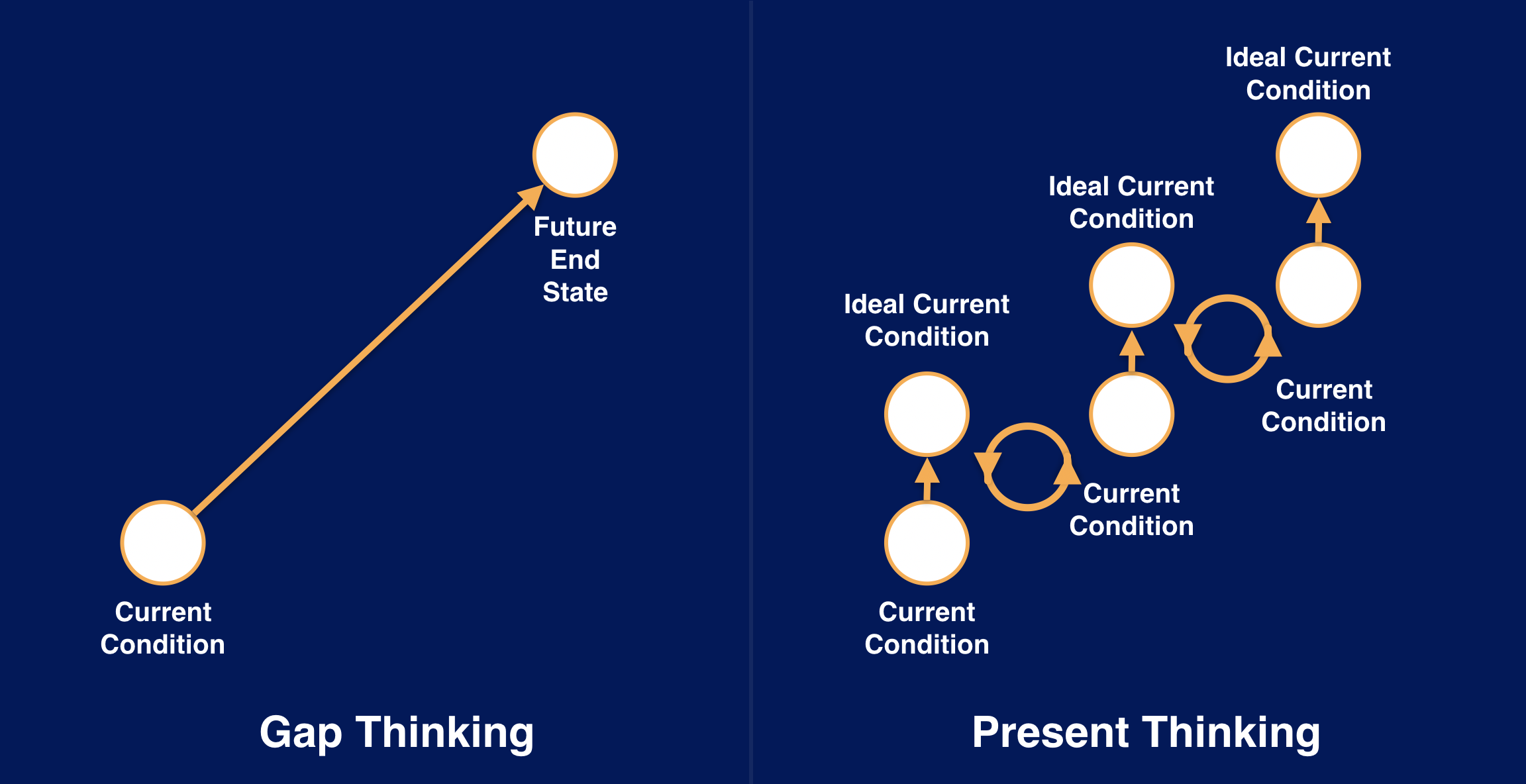
The major problem with gap thinking, as it relates to any change effort, is that teams become vested in a fixed endpoint that never materializes. They inadvertently devalue the present. There’s a lot of long-term planning and execution and long feedback cycles. When they don’t achieve the future—when they don’t close the gap—they lose steam and give up.
补差思维的主要问题在于,当它涉及到任何改变的努力时,团队会被赋予一个永远不会实现的固定终点。 他们无意中贬低了现在的价值。 有很多长期的计划和执行以及很长的反馈周期。 当他们无法实现未来时ーー当他们无法缩小差距时ーー他们就会失去动力而放弃。
If you find that your efforts to identify and implement a North Star for your product are losing momentum, you might be guilty of too much gap thinking.
如果你发现你为你的产品确定和实施北极星的努力正在失去动力,你可能会为太多的补差思维而感到内疚。
Bloom contrasts gap thinking with present thinking. In present thinking, you recognize the reality of the present and work to change it. Present thinking asks, 「Where are we? What do I need now? How do I improve the current way of working?」
布鲁姆将补差思维与当下思维进行了对比。 在当下思维中,你认识到当下的现实,并努力去改变它。 当下思维会问: 「我们在哪里? 我现在需要什么? 我如何改进目前的工作方式? 」
Teams that successfully implement frameworks like the North Star Framework are never 「done.」 They are always learning and grappling with uncertainty. The real muscle to develop is continuously checking to see whether your North Star Metric and Inputs represent your current beliefs, product vision, and product strategy—then refine accordingly.
成功实施北极星框架的团队永远不会「结束优化」,他们总是在学习,与不确定性作斗争。 真正需要做的是不断检查你的北极星指标标准和投入是否代表你当前的信念、产品愿景和产品战略,然后相应地完善。
To make the shift to present thinking, consider Jabe Bloom’s present thinking questions:
- 「Where are we?」
- 「What do I need now?」
- 「How do I improve the current way of working?」
为了转向当下思维,考虑一下杰贝•布鲁姆(Jabe Bloom)当前思考的问题:
- 「我们在哪里? 」
- 「我现在需要什么? 」
- 「我如何改进目前的工作方式? 」
Applied to the North Star Framework, the present thinking questions look like this:
- 「Can we align our current efforts more closely with our chosen Inputs?」
- 「What decisions do we need to make today and in the near future? Is the framework supporting those decisions? If not, how can we adapt it?」
- 「Can every team member trace current work to the North Star Metric? If not, what new context might we provide to help make the connection?」
- 「Has our confidence level in our chosen Inputs and North Star Metric increased or decreased in the last couple weeks? Why?」
- 「What have we learned recently? Let’s revisit our beliefs, value exchanges, etc. to see what needs tweaking.」
应用于北极星框架,当下思维考虑的问题看起来是这样的:
- 「我们能否使我们目前的努力与我们选择的投入更紧密地结合起来? 」
- 「我们今天和不久的将来需要做出哪些决定?框架是否支撑了这些决定?如果没有,我们如何适应? 」
- 「是否每个团队成员都能根据北极星指标来追踪当前的工作? 如果没有,我们可以提供什么新的背景来帮助他们和指标建立联系? 」
- 「在过去的几个星期里,我们对我们选择的投入和北极星指标的信心水平是增加还是减少了?为什么? 」
- 「我们最近学到了什么?让我们重新审视自己的信仰、价值观等,看看哪些方面需要调整。」
Chapter in Review
本章回顾
- After you’ve implemented the North Star, you may start seeing changes in culture, communications, customer behavior, and business results.
- You should regularly revisit your North Star to ensure it reflects your strategy and predicts results.
- Don’t be afraid to change your North Star if it is no longer working.
-
To maintain momentum, try shifting from gap thinking to present thinking.
- 在你实施了北极星之后,你可能会开始看到文化、交流、客户行为和业务结果方面的变化
- 你应该定期重新访问你的北极星,以确保它反映了你的战略和预测结果
- 不要害怕改变你的北极星,如果它不再工作
- 为了保持动力,尝试从补差思维转变到当前思维